Connect with confidence
Cofide is the open-standards identity platform that secures application workloads and AI agents across any cloud environment.
Every workload has its own verified, short-lived identity, enabling identify-first security and robust protection of your data and services.
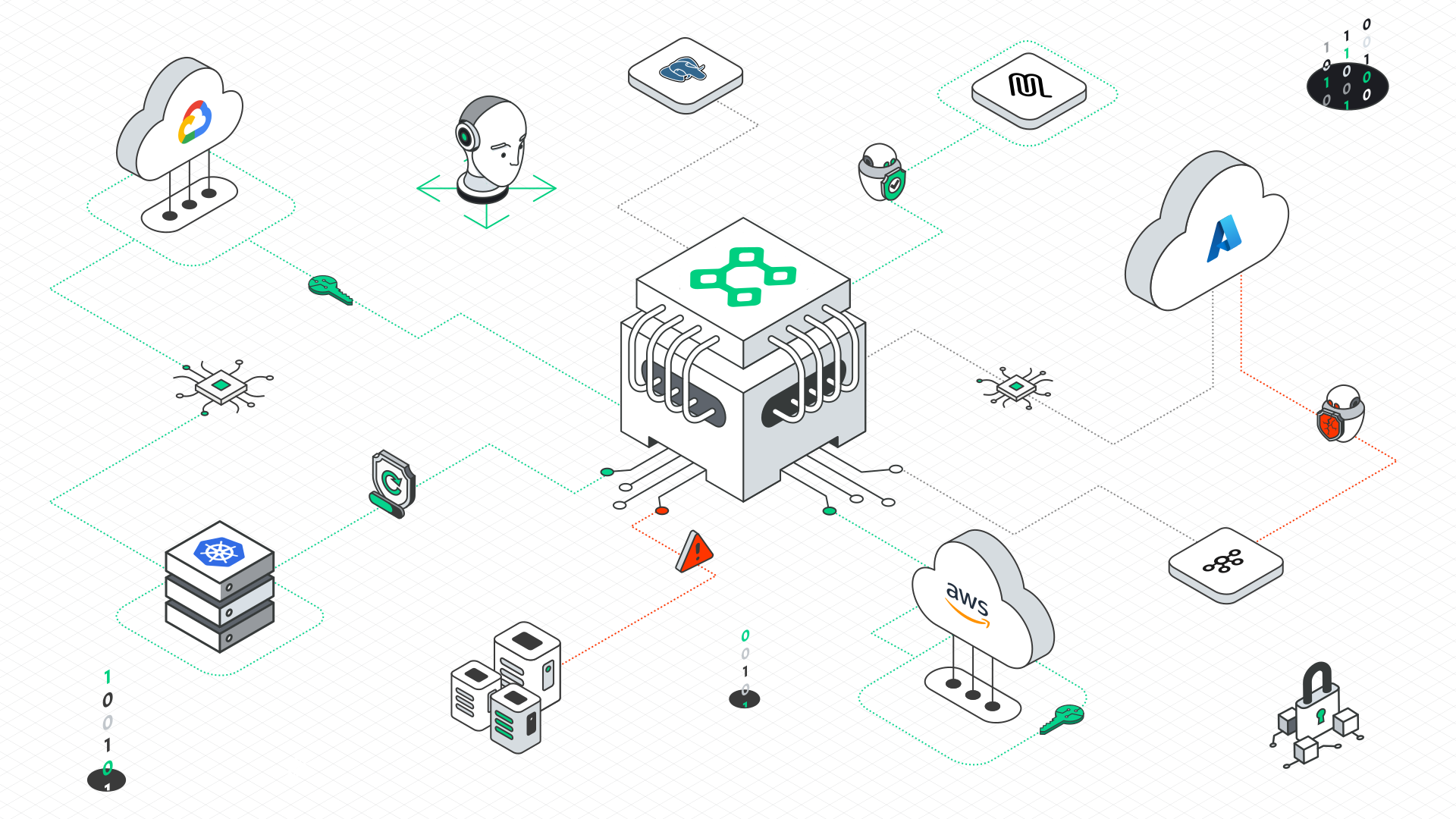
The Non-Human Identity Crisis
Cloud-native workloads and AI agents have created an explosion of Non-Human Identities — now more than fifty times greater than human ones.
API keys, tokens and service accounts are often long-lived and rarely rotated, leaving organisations exposed. With limited automation and poor visibility, IAM has become one of the most overlooked cloud security risks. This unmanaged sprawl is a growing attack surface at the heart of every organisation.
Security that accelerates progress
Cofide helps organisations move faster while reducing risk and cost. It removes static secrets, simplifies compliance and automates identity at every stage of delivery.
Reduce breach risk
Remove static secrets and the human error that comes with managing them.
Save time and resources
Automate workload identity lifecycle management so your teams can focus on building.
Accelerate delivery
Remove identity bottlenecks so teams can ship faster across any environment — without compromising security.
Interoperable by design
Built on open standards — SPIFFE, SPIRE, OAuth, and OIDC — so trust between workloads is verifiable and portable.
The open-standards platform for zero-trust workload identity
Replace secrets and static credentials with cryptographic identity that workloads carry with them. Secure identity for every workload and AI Agent, across any cloud.
Identity-first security
Secrets are weak. Tokens can be stolen. Cofide replaces them with cryptographic proof that verifies what a workload is — not just what it knows — anchoring trust to identity itself.
No secrets. No compromises.
Cofide issues short-lived identities automatically at runtime, each verified and scoped to its role. Workloads communicate securely without vaults, rotation, or shared secrets — a simple, automated fix for one of cloud security's biggest weaknesses.
From visibility to verified trust in three steps
See how workloads connect
Cofide maps workloads and service interactions across clusters, giving you full visibility through a live TrustMap.
Spot risks immediately
Surface static credentials, long-lived secrets, and insecure connections before they become problems.
Fix issues fast
Take swift action to mitigate risks and onboard workloads to Cofide Connect.
Control identity with context
Use workload, cluster, and infrastructure attributes to control how workloads are attested and dynamically issued short-lived identity.
Build trust across clouds
Define trust federation relationships between workloads across clusters, cloud providers, and SaaS platforms.
Manage everything as code
Configure and manage all Cofide resources through APIs and policy-as-code — no manual intervention required.
Integrate without replacing
Use the Cofide SDK, sidecar, or integrate directly with your existing service mesh — no rip-and-replace.
Get short-lived credentials automatically
Cofide issues dynamic, short-lived workload credentials at runtime — no vaults, no rotation schedules.
Access clouds and APIs securely
Exchange workload credentials to securely access cloud providers and SaaS APIs without static keys.
Deploy anywhere. Integrate easily.
Cofide fits naturally into modern infrastructure. It’s Kubernetes-native, deployable across cloud and on-premises environments, and designed for straightforward integration.
Deploy anywhere
Kubernetes-native for cloud and on-premises
Plug into existing infrastructure
Works with Kubernetes, service mesh or the Cofide SDK
Ready-to-go integrations
Connect with cloud providers and popular SaaS systems
Beyond traditional IAM
From static secrets to cryptographic identity — in four steps.
Detect workload context
Cofide observes workload attributes and runtime environment
Verify identity cryptographically
Cryptographic attestation proves the workload is what it claims to be.
Issue short-lived credential
A unique, time-bound credential is issued at runtime.
Connect securely
Workloads authenticate using verified identity, not shared secrets.
Workload identity, open standards and getting started with Cofide.
Cofide provides cryptographically verified identity for workloads so they can authenticate to each other without relying on static secrets like API keys or long-lived tokens. It replaces high-risk shared secrets with short-lived, verifiable credentials issued and rotated automatically at runtime.
Cloud-native workloads and AI agents have created an explosion of non-human identities — now more than fifty times greater than human ones. API keys, tokens, and service accounts are often long-lived and rarely rotated, leaving organisations exposed. Secret sprawl and misconfiguration are now leading sources of security breaches. Workload identity replaces manually managed keys with consistent, auditable trust across environments.
IAM focuses on human users and permission models. Secrets managers store and rotate static keys. Cofide issues dynamic, cryptographically verified identities using open standards, so workloads authenticate based on what they are — not what secret they hold. This eliminates most long-lived credentials for workloads entirely.
Cofide uses open, industry-backed standards — SPIFFE, WIMSE, OAuth, and OIDC — for issuing and verifying workload identities. This provides strong cryptographic trust while keeping your architecture flexible and portable across providers.
Cofide Connect is Kubernetes-native and works with service mesh, SDK-based, or proxyless deployments. It fits into existing CI/CD, cloud IAM, PKI, mesh, and API infrastructure without requiring major application refactoring.
Yes. Cofide provides a consistent identity layer across clusters, clouds, and on-premises systems, so workloads can authenticate securely regardless of where they run or how your architecture evolves.
Yes. While Cofide Connect is Kubernetes-native, it also supports workloads running on virtual machines in cloud environments with TPM-backed attestation, on-premises systems, and serverless platforms including Google Cloud Run and AWS Lambda. The identity model is consistent across all environments — workloads receive the same short-lived, cryptographically verified credentials regardless of where they run.
AI agents present a new identity challenge: they act autonomously, call external APIs, and often operate across trust boundaries. Cofide provides short-lived, cryptographically verified identity to agent workloads, proving what the agent is through attestation. It then enables seamless token exchange to preserve and propagate who the agent is acting for — maintaining user identity and intent as requests flow across services and providers. This gives organisations the same auditable, standards-based trust for agentic workflows that Cofide provides for any other workload.
Cofide removes the operational burden of managing secrets, eliminates manual rotation, and cuts the risk of credential-related outages or breaches. Teams ship faster, security teams gain visibility and control, and environments become easier to govern as they scale.
Cofide issues short-lived credentials that expire automatically, limiting the blast radius of any compromise. Compromised identities can be revoked instantly, and all rotation is handled as part of the runtime identity lifecycle.
Most engineering teams complete an initial evaluation within a few weeks using Kubernetes and out-of-the-box integrations — sidecar, mesh, and SDK. Rollouts can start small and expand incrementally as confidence grows.
No. Cofide complements existing IAM, secrets managers, CAs, policy engines, and cloud-native tools. It reduces the amount of secret material workloads need to handle, improving your overall security posture without forcing a full-stack replacement.